


The Thirty Meter Telescope International Observatory (TIO) is excited to announce the successful completion of the Secondary Mirror Metrology & Polishing Final Design Review (FDR). The FDR was held at the James C. Wyant College of Optical Sciences at the University of Arizona in Tucson, Arizona on February 13, 2026 and included both in-person and remote attendees.
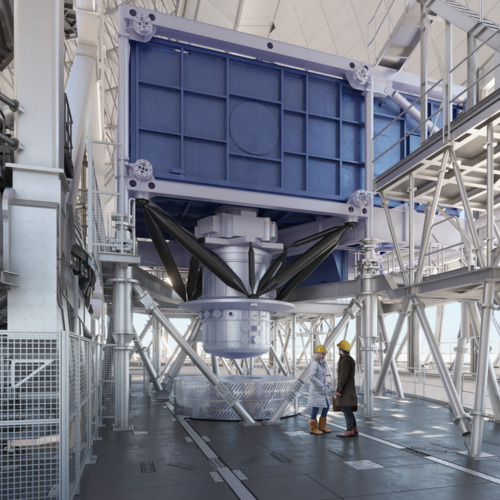
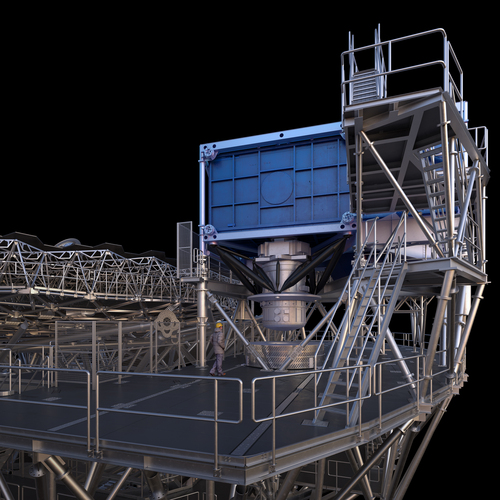
Following a global Request for Proposal process, TIO selected the Optical Engineering and Fabrication Facility (OEFF) at the University of Arizona James C. Wyant College of Optical Sciences for the precise and delicate work required for the metrology and polishing of the secondary mirror (M2). Work commenced in the spring of 2025 to design the suite of tools needed for the state-of-the-art metrology to guide polishing of the M2 and verify compliance of its optical surface with all requirements. As a vital component of the Thirty Meter Telescope, this convex aspheric mirror must have an extremely precise optical surface for the telescope to achieve its groundbreaking performance. It will be one of the largest convex mirrors ever created with an impressive diameter of 3.13 m (10.3 ft) and weighing in at 2000 kg (4410 lbs). A rendering of the M2 system mounted on the telescope is shown below.
A realistic simulation of the Thirty Meter Telescope's Secondary Mirror System. The secondary mirror reflects the light from the primary mirror and converts it to the beam for the science instruments. Image credit: TMT International Observatory
Ths design review included contributions from six TIO subject matter experts across multiple disciplines with an emphasis on precision optics and metrology. Ben Gallagher, TIO Telescope Optics Group Leader, chaired the review. In addition, several TMT stakeholders attended the review meeting and participated as observers.
The design team consisted of TIO staff, led by Art Mihill, M2 Engineer, alongside the OEFF team led by Chang Jin Oh, Technical Director, from the University of Arizona James C. Wyant College of Optical Sciences. This work was carried out under a contract between TIO and the University of Arizona, and funding for this work was awarded to TIO through the U.S. National Science Foundation design and development funding. A photo of FDR participants is shown below.
Secondary Mirror Metrology and Polishing FDR participants at University of Arizona in Tucson and remote.
At the FDR meeting, multiple presentations were made by the OEFF team. In concert with the TIO Optics and Systems Engineering teams, they delivered a comprehensive FDR demonstrating the maturity, completeness, and compliance of the final design.
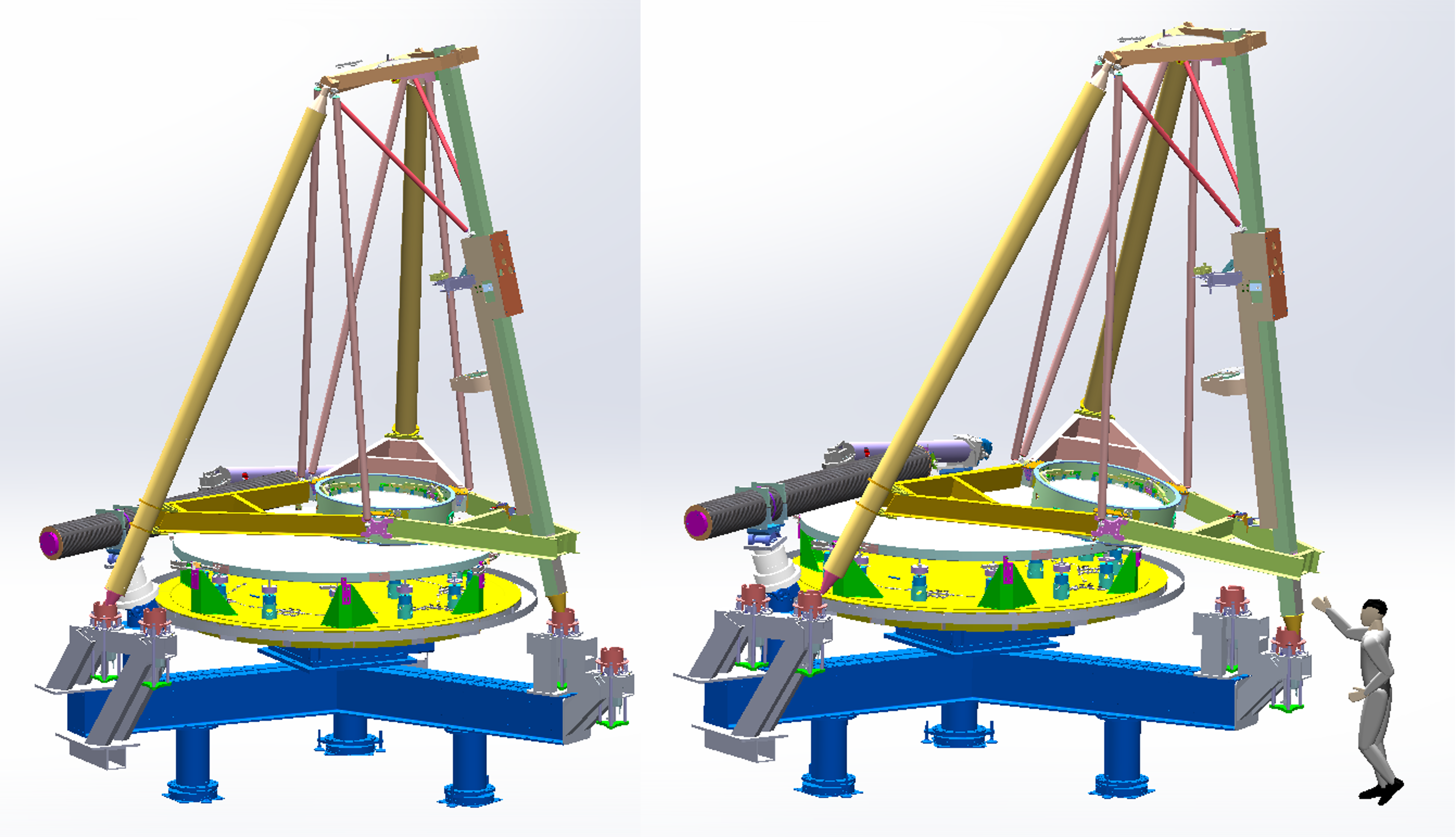
A sub-aperture Fizeau Test System has been designed for the primary optical surface metrology. CAD images of M2 under test are given below. Several other instruments have been designed to cover the full range of spatial frequencies on the optical surface and to provide feedback during the early grinding and polishing stages. The polishing/metrology support for M2 is a key component of the metrology and its performance has been analyzed during design. Safe handling of such a large, heavy mirror is also extremely important. Tools for lifting and flipping of the M2 have also been designed and thoroughly analyzed.
CAD renderings of the sub-aperture Fizeau Test System for M2 optical surface metrology. M2 is shown on its polishing/metrology mount on the polishing center. The test components are mounted on the tripod for efficient removal during polishing operations. The image at left shows the tripod in position to measure the inner ring of sub-apertures and in the image at right it is configured for the outer ring. Image credit: University of Arizona
During the meeting, the review panel focused on five charge questions to evaluate essential aspects of the design and later offered praise in their review report stating, “This conclusion reflects the subsystem's design maturity, comprehensive documentation, and well-developed verification and risk management plans. The committee commends the University of Arizona team for their thorough preparation and responsiveness throughout the review process.”
Key recommendations for the final design phase consist of a small number of open actions which are well defined and will be addressed in alignment with the milestones of FDR closeout and/or the Production Readiness Review in the next phase of work.
During assembly of the telescope, the polished M2 will be integrated into its Support System and Positioner Assembly (M2SSP) to form the complete M2 System of TMT. The M2SSP has been designed by TIO contractor Advanced Mechanical and Optical Systems (AMOS), in Liège, Belgium and passed its FDR in June 2025. The M2 Metrology and Polishing Equipment has now joined M2SSP in the Production Readiness phase marking significant progress in the development of the full M2 System and a major milestone for TMT.
We extend our gratitude to all participants for the close collaboration, thoroughness, and technical excellence. We look forward to continued success as we enter the Production Readiness phase of the M2 Metrology & Polishing contract.
This material is based upon work supported by the U.S. National Science Foundation under Cooperative Agreement No. 2437863. Any opinions, findings and conclusions or recommendations expressed in this material are those of the author(s) and do not necessarily reflect the views of the U.S. National Science Foundation.
ITCC Stress Mirror Polishing FRR Successfully Completed
The Government of Spain, with the European Investment Bank, announces a proposed financial framework to support building the Thirty Meter Telescope