


IRIS team and FDR-1 reviewers and observers on-line and in-person.
IRIS team and FDR-1 reviewers and observers on-line and in-person.
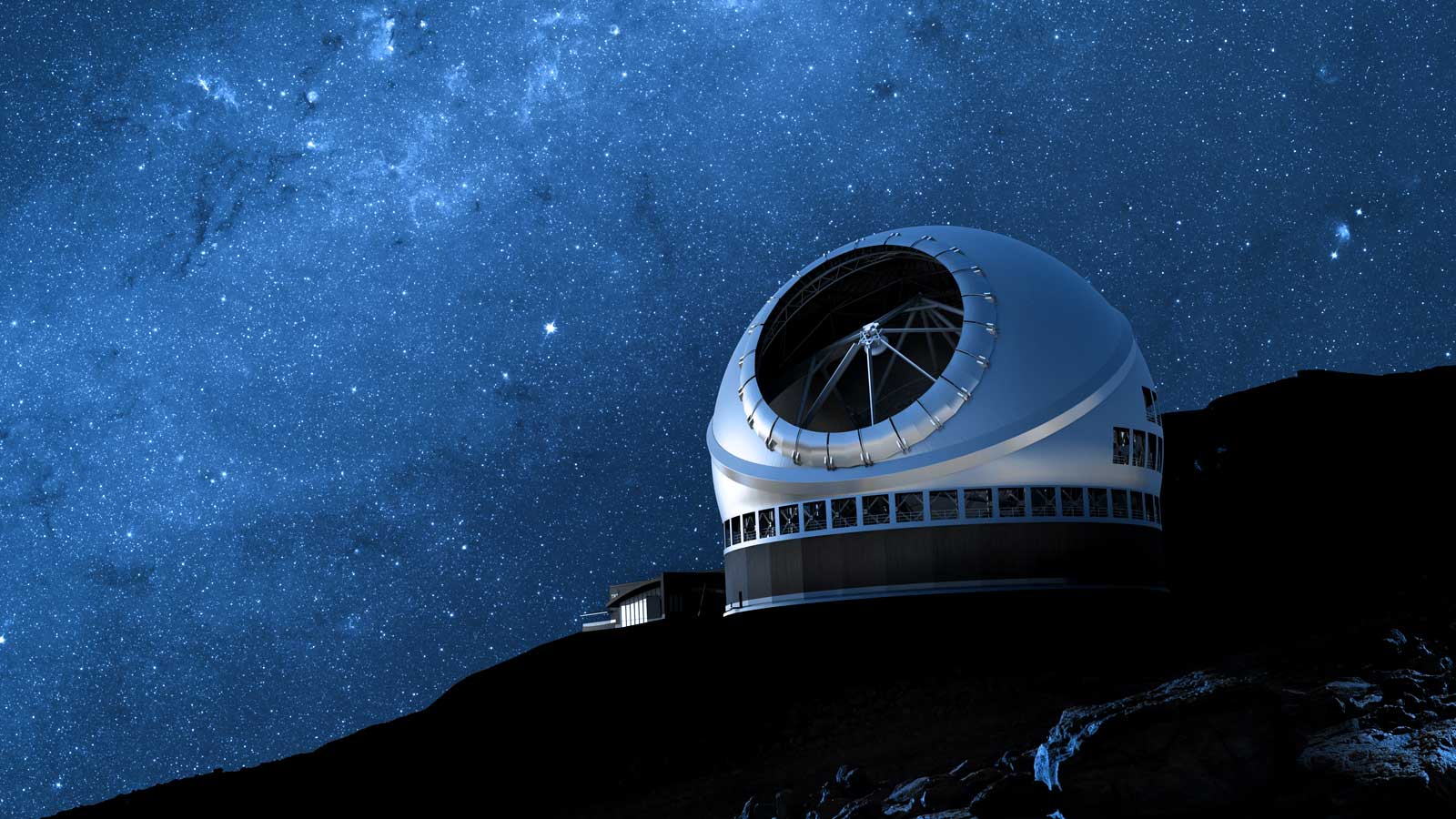
The Thirty Meter Telescope (TMT) International Observatory (TIO) is pleased to announce the successful completion of Final Design Review–1 (FDR-1) for the InfraRed Imaging Spectrograph (IRIS), held on December 8–9, 2025. IRIS is TMT’s flagship first-light near-infrared imager and integral field spectrograph, designed to operate with the observatory’s adaptive optics system NFIRAOS, will deliver unprecedented diffraction-limited imaging and spectroscopy.
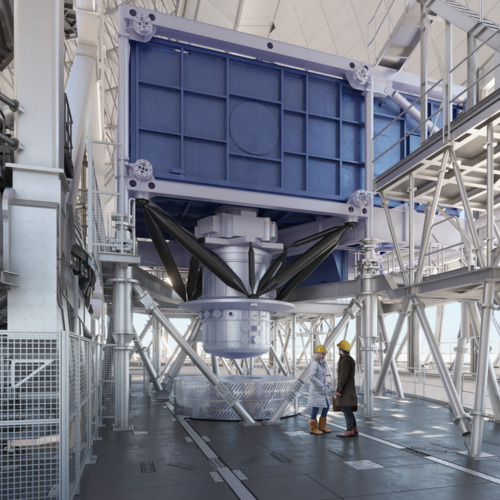
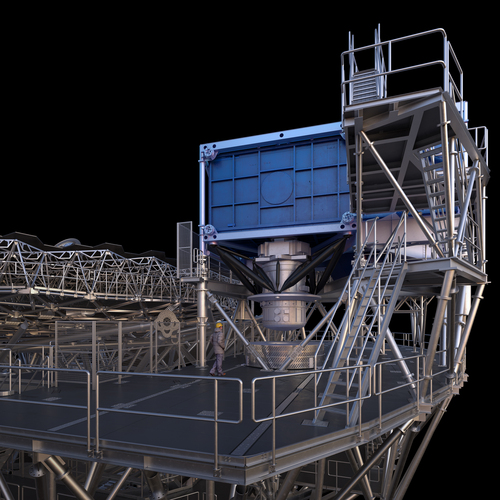
Rendering of IRIS mounted under NFIRAOS on TMT.
Cross-sectional view of IRIS pointing out major subsystems.
By pairing a wide-field near-infrared imager with a powerful integral field spectrograph, IRIS will observe the universe across wavelengths from 0.84 to 2.4 microns. These capabilities will enable transformational science ranging from Solar System targets and exoplanets to precision studies of the Galactic Center and spatially resolved spectroscopy of the first galaxies. IRIS on TMT is so sensitive it will reach the depth of the Hubble Deep Field in just 20 minutes!
Simulated galaxy at a redshift of ~1 as observed by the IRIS Integral Field Spectrograph in 2 hrs. Thousands of spatially sampled spectra allow astronomers to dissect galaxies and understand their kinematic structure (right), their star formation rates, and metallicities (credit UCSD OIRLab).
IRIS is being developed through a broad international collaboration. The project is led by Principal Investigator James Larkin at UCLA, Project Scientist Shelley Wright at UC San Diego, and Project Manager Kanaka Warad at TIO, alongside Systems Engineer Ryuji Suzuki at the National Astronomical Observatory of Japan (NAOJ), Mechanical Lead Bob Weber at Caltech, Lead Optical Engineer Renate Kupke at UC Santa Cruz, and Software Lead Jennifer Dunn at NRC Canada. The team includes over 30 scientists and engineers across these institutes. The project is also guided by an International Science Advisory Committee with eminent members from institutions across the United States, Canada, and Japan, ensuring strong scientific alignment with the evolving interests of the broader astronomy community.
IRIS team and FDR-1 reviewers and observers on-line and in-person.
FDR-1 was reviewed by an independent international panel chaired by Corinne Boyer, TIO Adaptive Optics Group Leader. The panel included experts from the National Astronomical Observatory of Japan (NAOJ) , the National Research Council of Canada (NRC), and the TMT International Observatory (TIO), with external observers from the Instituto de Astrofísica de Canarias (IAC), the W. M. Keck Observatory (WMKO), and Teledyne Technologies. Key IRIS design highlights included the transition to Teledyne H4RG-15 detectors, completing the LN2 auto-fill system design, extensive prototyping and analyses demonstrating that all system-level performance budgets can be met. The review committee commended the IRIS team for developing an exceptional instrument that will fully utilize the capabilities of TMT and NFIRAOS.
The successful completion of FDR-1 marks a major milestone in the development of IRIS and reinforces the project’s readiness to advance into the next phase of final design and preparation for fabrication. This progress brings TMT closer to first light and to delivering transformational near-infrared science for the astronomy community.
TIO extends our gratitude to all reviewers and IRIS team members.
TMT Explores a Promising Path Forward in Spain
Global Astronomy Community Articulates the Scientific Case for a Northern Hemisphere Extremely Large Telescope